
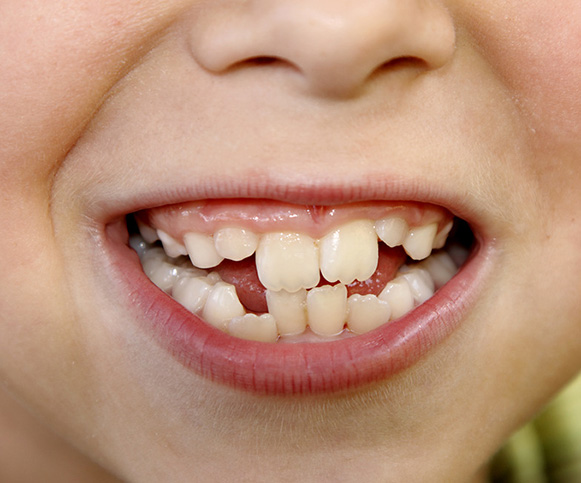
Early treatment in the primary dentition
We recommend having your child's dentition examined in good time to check that it is functioning properly. Irregularities in the primary dentition often continue into the permanent dentition. With some misaligned teeth it therefore makes sense to begin correction while the baby teeth are still in place.
Initial orthodontic check-ups can be useful from the age of three to five – at this age all the baby teeth are present, and misalignments or dysfunctions can be identified clearly.
An early look is particularly advisable if a child lisps, has sucked its thumb for a longer period or has used a dummy for a long time.
Common early treatment measures
With early, corrective therapy you often spare your child more complex measures later on. These include, for example:
- stopping habits such as thumb sucking, lip biting or tongue thrusting
- closing an anterior open bite
- correcting a crossbite in the front or side tooth area
- keeping gaps open with a space maintainer after early loss of a baby tooth
- pronounced lack of space due to a jaw that is too small
- supernumerary teeth
Straight teeth for a whole lifetime: the earlier we identify a developmental problem, the more gently it can be steered in the right direction.
The most important points at a glance
- Initial orthodontic check-ups are useful from the age of three to five.
- Particularly advisable if a child lisps, has sucked its thumb for a longer period or has used a dummy for a long time.
- Typical measures: stopping habits, closing an open bite, correcting a crossbite, keeping gaps open.
- Pronounced lack of space and supernumerary teeth also become apparent in this phase.
- Early, corrective therapy often spares more complex measures later on.