
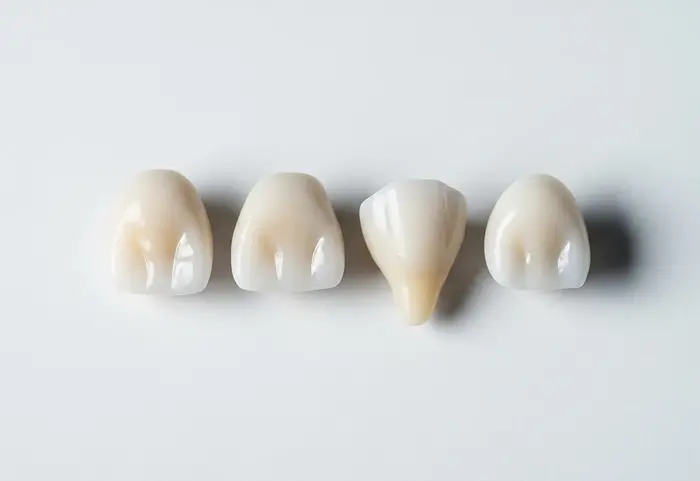
Children's crowns for badly damaged baby molars
Compared with permanent teeth, baby teeth have a considerably larger nerve and a thinner layer of hard tissue. This makes them more susceptible to decay.
If a baby tooth is affected on several surfaces, a filling is often no longer sufficient. Then – as with adults – a crown can stabilise the remaining hard tooth substance and save the tooth.
What a crown for a baby tooth achieves
Prefabricated crowns are fitted onto the baby molar – in one session, without an impression for a laboratory.
Protection
The crown completely encloses the tooth and protects it from further decay.
Shape and function
Even with deep decay it restores the chewing surface and tooth shape.
Space maintainer
The preserved tooth keeps the space free for the permanent tooth.
Gone again by itself
Later the crowns fall out completely by themselves together with the baby tooth.
When we advise a crown
Whenever too little healthy substance is left of a baby molar to anchor a filling securely. Rather than pulling the tooth and keeping the gap open at great effort, we prefer to preserve it.
We discuss this calmly with you and show your child beforehand what will happen. We only begin the treatment once it feels safe.
The most important points at a glance
- Prefabricated children's crowns are fitted in one session – without an impression for a laboratory.
- The crown completely encloses the tooth and protects it from further decay.
- It restores the chewing surface and tooth shape, even with deep decay.
- The preserved tooth keeps the space free for the permanent tooth.
- Later the crown falls out completely by itself together with the baby tooth.